
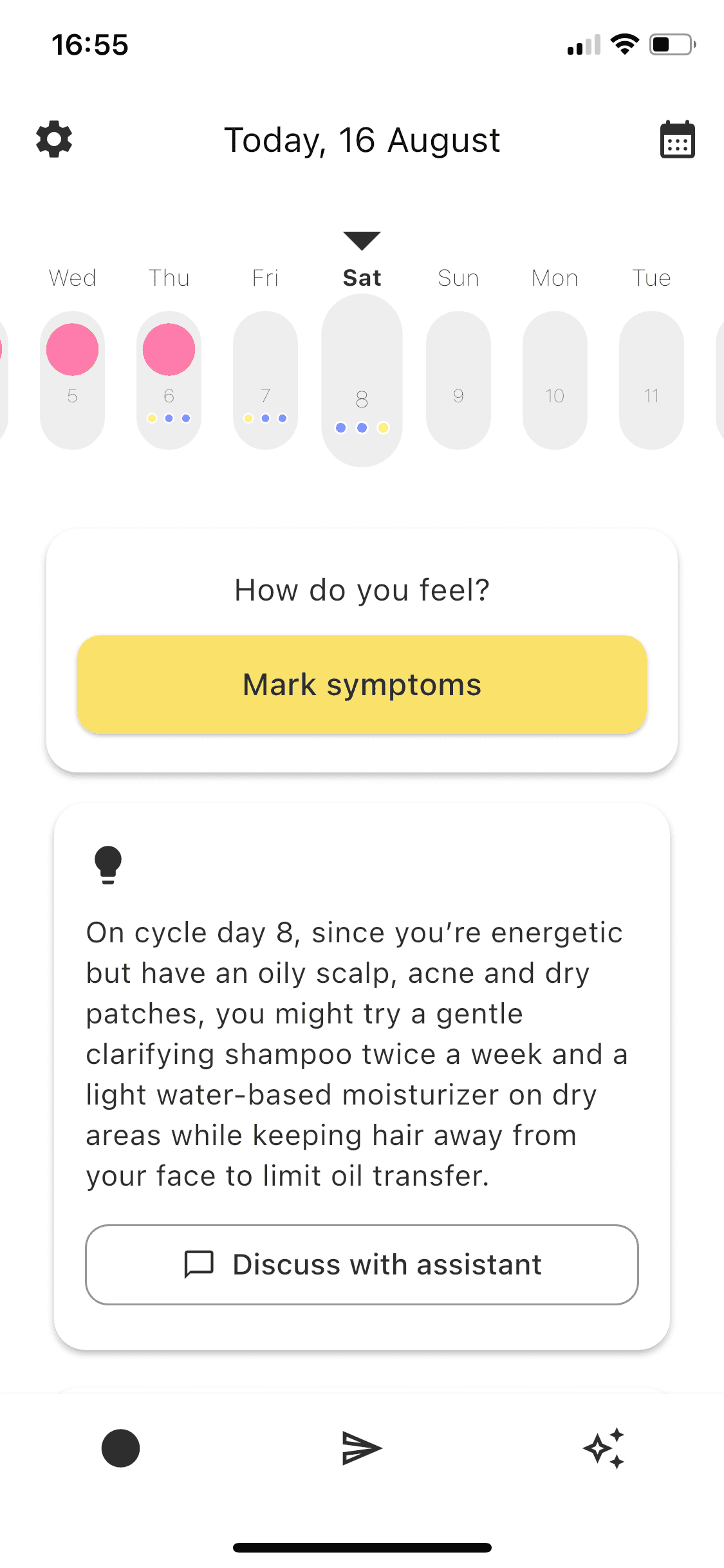

Understanding the Body
Predicting symptoms, tips on "what's normal and when to be cautious"
Track your cycle, symptoms and get helpful reminders. Read vetted health articles right in the app. Install IVA — start understanding yourself better.

Predicting symptoms, tips on "what's normal and when to be cautious"

IVA monitors the connection between hormonal balance and mental state.

Early detection of symptoms, health care

IVA breaks down communication barriers: you can easily share what you feel and want, while your partner gets clear cues to understand you better.
Install IVA from the App Store or Google Play — sign up in 30 seconds.
Record your data daily — IVA remembers and analyzes it for you.
Personal tips, cycle predictions and articles selected just for you.
IVA offers a caring library of educational articles about women’s health. All content is free and always available.
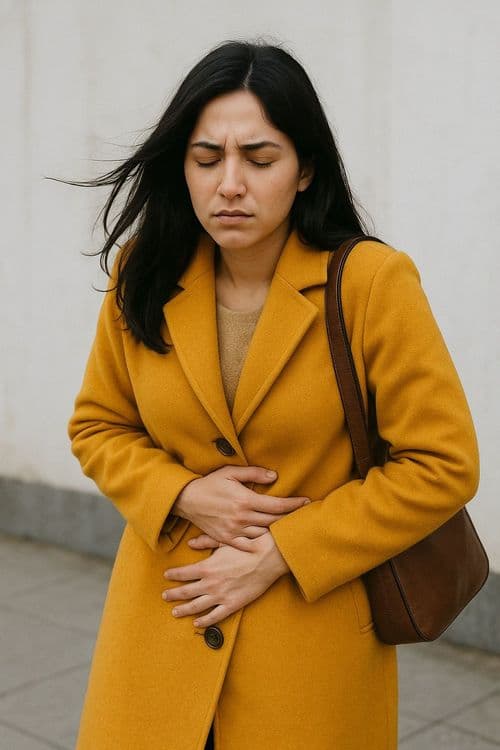
# Painful Periods: Why They Happen and What to Do About It Periods can feel very different for different people. For some, they pass almost unnoticed, while for others each cycle turns into a challenge: stomach cramps, back pain, no energy, and the urge to curl up and cancel everything. Pain during menstruation is common. It’s caused by uterine contractions: the uterus is *“pushing out”* the unnecessary layer of endometrium. Sometimes these contractions are stronger than needed, and that’s when cramps occur. For some, the pain starts a day before the period, for others — on the first or second day. It may last a few hours or a couple of days. Sometimes it comes with nausea, headaches, or weakness. Why does it barely hurt for some, but hurts every time for others? The reasons vary: hormone levels, individual pain sensitivity, diet, stress, and sleep all play a role. Sometimes painful periods can also be a sign of conditions such as endometriosis or adhesions, and in that case, it’s important to talk to a doctor. ## What Can Help? - **Warm heating pad on the stomach** — heat relaxes the muscles and eases cramps. - **Calm and rest** — sometimes the body simply needs to slow down. - **A short walk** — movement improves blood flow and may relieve pain. - **Pain relief** — ibuprofen or paracetamol often help, especially if taken in advance. - **Sleep and nutrition** — lack of sleep and coffee on an empty stomach can worsen symptoms. - **Cycle tracking** — if you know which days the pain usually comes, you can prepare ahead of time. --- If pain interferes with daily life, you don’t need to just endure it. Constant strong pain is not *“just how your body is.”* It’s a signal. And it deserves attention. In **IVA**, you can track when the pain is strongest, how it changes, and what helps you. This way, you start to better understand your body and take care of yourself in advance.
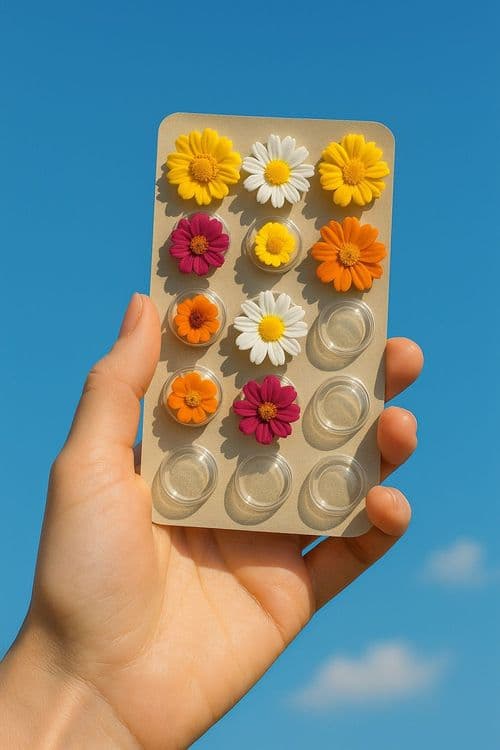
# Myths and Facts About Hormonal Contraception Hormonal contraception causes many fears. Some say it makes you gain weight, others claim it "ruins" your cycle or makes you less feminine. Let's figure out what's true and what's just myths passed down by word of mouth. ## 🧨 Myth 1: Hormones "ruin" the cycle **Fact:** hormonal contraception simply creates a different type of cycle. It suppresses ovulation, and instead of a natural cycle, an artificial rhythm occurs. This is safe and controlled, especially if you have chosen the right method with a doctor. ## ⚖️ Myth 2: Everyone gains weight from pills **Fact:** weight gain does not happen to everyone and is not always due to the pills. Some notice slight fluid retention or changes in appetite, especially at the beginning of taking them. But this is temporary. Studies do not confirm that hormones cause significant and persistent weight gain. ## 🚫 Myth 3: Taking hormones makes you "unfeminine" **Fact:** contraception does not cancel your sexuality, emotions, and individuality. Hormone levels change, but you can still feel vibrant, attractive, and lively. For some, libido even improves because the fear of pregnancy or menstrual pain disappears. ## 🧬 Myth 4: It's hard to get pregnant after hormones **Fact:** fertility returns quickly. Most women resume ovulation within 1–2 months after stopping. If pregnancy does not occur for longer, the reason is likely not contraception but other individual factors. ## 🔄 Myth 5: If there are no periods while taking it, it's harmful **Fact:** this is not a "delay," but a normal reaction of the body to a constant hormonal background. With some regimens, menstrual bleeding may become very light or disappear altogether. This does not indicate a problem — rather stability in hormone levels. ## 😟 Myth 6: Everyone has bad moods from hormones **Fact:** it all depends on the body. Some people's moods may indeed change. For others, on the contrary, hormones stabilize the emotional background and reduce PMS symptoms. If something goes wrong, the method can always be adjusted. --- ## 💬 The main thing is to find what suits you Hormonal contraception is not scary chemistry but a tool. If chosen wisely, it doesn't interfere with your nature but helps you manage your life. **IVA** is here so you can note how you feel while taking it, see patterns, and notice if the current rhythm suits you.
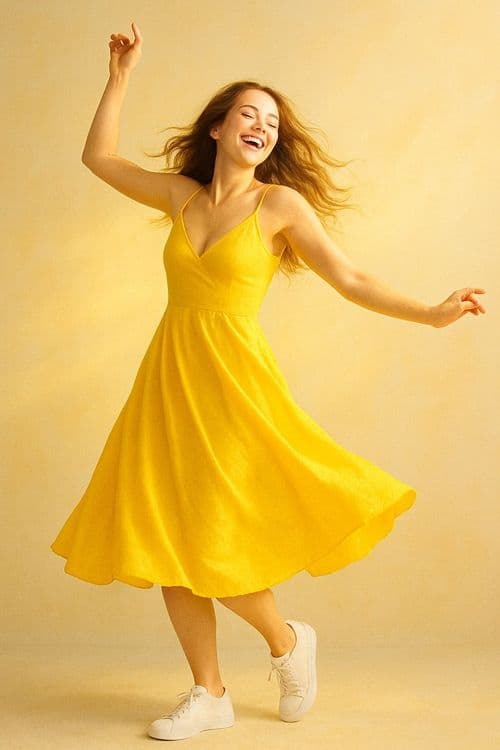
# Why Do You Feel Like Flirting During Ovulation? Sometimes you look in the mirror and like what you see. You want to wear something brighter, go out, and catch glances. Sometimes you feel light, playful, and particularly attractive. It's not magic. It's ovulation. ## 🔬 What is Ovulation? Ovulation is the moment in the middle of the cycle when an egg is released from the ovary. This is the most 'fertile' period—if unprotected sex happens at this time, the chance of conception is highest. At this moment, the body is not just waiting to meet a partner—it seems to say: *"Look, I'm ready. Are you?"* ## 💃 What Happens to the Body and Mood? During ovulation, estrogen levels rise and testosterone increases slightly—a hormone responsible, among other things, for sexuality and initiative. Thanks to this: - energy and mood increase - libido is heightened - a sense of self-confidence appears - skin appearance improves, eyes shine, expressions become lively - you want to be noticed, heard, and attractive This doesn't mean you have to flirt. But during this time, many feel particularly 'in the flow': craving communication, touch, light play, and attention. ## 🌀 Is This Normal? Absolutely. It's an ancient, built-in mechanism. But it doesn't oblige you to relationships, sex, or flirting. It simply shows that the body is working in rhythm. Some use this time for dates and creativity. Others simply enjoy the good mood and keep it all to themselves. You may want attention, or you may want silence. The main thing is not to be ashamed of your feelings. Because you're not "too sensitive"—you're just in a moment of strength. ## 💬 How is This Related to IVA? In the app, you can mark your state during ovulation. Compare feelings, desires, and energy levels. This helps you understand: you're not 'weird' or 'changeable'—you're simply alive. And you have your own internal rhythm.

# Emotional Swings: When It's Hormones and When It's Something More Sometimes everything is fine, and an hour later — tears. Today you want to hug, and tomorrow — you don't want to touch anyone. Mood swings as if there's a small storm inside. It can be frightening, especially if it's unclear why it's happening. The first thought is, "it's probably hormones." And often, that's correct. ## 📊 When is it hormones? The female cycle is not just physical changes. Hormones directly affect emotions, stress response, irritability, and even self-esteem. - **The first half of the cycle** — when estrogen rises, mood usually stabilizes, it becomes easier to be happy, communicate, focus. - **The second half of the cycle** — closer to PMS, estrogen drops, and progesterone increases. Sensitivity, anxiety, and a desire to be alone appear. - **Before menstruation** tears often arise for no reason, a feeling that "everything is wrong" and the world is pressing. If these changes occur at about the same time in the cycle and disappear with its end — it's likely hormonal swings. They are natural, and you can learn to handle them gently. ## 🔍 And when is the reason deeper? Sometimes emotional swings become too frequent or severe. For example: - Mood changes sharply every day, not just by cycle phases - Tears, apathy, or anxiety interfere with living, working, sleeping - You increasingly feel guilt, emptiness, or meaninglessness - The body feels foreign, and thoughts — like incessant noise If any of this is familiar to you — it may not just be hormones. This doesn't mean there's something wrong with you. It means you're tired, perhaps holding feelings inside for a long time, or experiencing something you don't speak about aloud. Psychological states, burnout, depression, chronic stress — all these can disguise themselves as "mood whims." If you're struggling — it's important not to endure and not to wait for it to "pass on its own." Support is needed not only for those who are "doing badly" but for everyone who wants to feel better. ## 💬 What can be done? - Keep a diary of states and track cycle phases - Talk to those you trust - Seek help, even if it "doesn't seem critical" - Don't devalue yourself and your feelings --- **IVA** — is not just about the body. It's about inner honesty with yourself. Here you can note emotions, see connections, and gradually find your rhythm. Even if everything seems confusing now — you are already on the path to yourself.
 Daria
Daria Ilya
Ilya“We are Daria and Ilya — partners in life and at work. IVA was born from our own need.”
We listened to people around us, explored open communities and existing trackers — and realized millions of women face similar challenges: understanding their body and cycle, communication in a couple, and lack of accessible health information.
That’s how IVA appeared — a product that helps with real tasks: understanding your body and cycle, communicating as a couple, and paying more attention to your health.
Yes — core tracking features and the article library are completely free.
All data is encrypted and stored on secure servers. We never sell or share your data with third parties.
Not for logging symptoms. AI insights and articles require a connection.
Yes — your partner can see cycle predictions and reminders if you allow it.
IVA is available on iPhone (iOS 16+) and Android (8+).
Reach out to us on any social network or through the in-app form — we reply within a day.